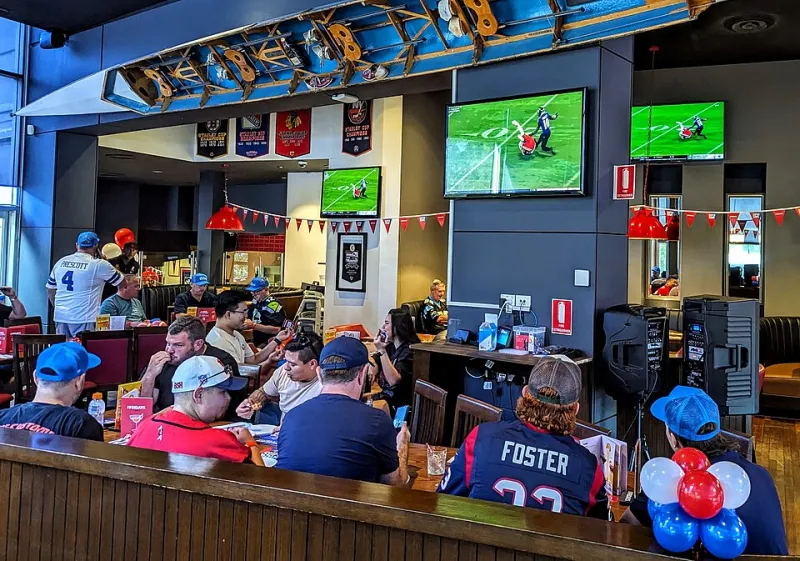
The Barstool Tax: How 'Background Betting' Quietly Drains Your Bankroll Every Week

Photo: Martin Falbisoner, CC BY-SA 4.0, via Wikimedia Commons
The Bet You Forgot You Placed
Here's a scenario every casual bettor in America knows by heart. You're at a buddy's birthday dinner when somebody checks their phone and goes, "Oh, the Lakers are live right now." Two minutes later, everyone at the table has dropped a wager. Nobody's watching the game. Nobody checked the injury report. Half the table doesn't even know the spread.
That's what we're calling the barstool tax — the slow drip of bets placed on games you aren't actually watching. Individually, each one feels harmless. Twenty bucks here, a fun little parlay there. Collectively, they're the single biggest silent leak in the average recreational bettor's week.
The Math Nobody Wants to Do
Let's put real numbers on it, because this is where the habit falls apart under scrutiny.
Say you're a typical casual bettor. You have your "real" weekend — maybe two or three NFL bets on Sunday that you actually watch, study, and sweat. That's your intentional action. But during the week, the background betting kicks in:
- Monday night, you toss $20 on a total while scrolling at the bar
- Tuesday, a random NBA game you caught mid-scroll, $15
- Wednesday, a college basketball game because the app pushed a notification, $25
- Thursday, a late MLB total while waiting for your food, $10
- Friday, two impulse bets during happy hour, $50
That's $120 a week on games you didn't watch, didn't research, and in most cases can't even remember by the time Sunday rolls around. Over a month, that's nearly $500 of essentially untracked action. Over a full year? We're pushing $6,000.
Now here's the part that stings. A bettor who researches and watches their games might hit 54% against the spread over time — enough to grind out a small profit or at least break even after the vig. A bettor firing blind at games they're not watching? You're basically flipping a coin at minus-110 odds. At a realistic 46-48% win rate, that $6,000 a year leaks away at a pace of $400 to $600 annually — every year, forever, without a single memorable bad beat to show for it.
And that's the insidious part. Bad beats stick in your memory. The background losses don't. Your brain files them under "fun weekend stuff" while the bankroll quietly bleeds.
Why We Do It: The App Made It Too Easy
Twenty years ago, background betting required effort. You had to call a guy or drive somewhere. Today, the sportsbook lives on the same screen as your group chat, and it knows exactly when to ping you.
Push notifications about "trending bets." One-tap deposits. Boosted odds tokens that expire in an hour, engineered to make you feel like skipping them costs you money. The whole mobile experience is optimized for exactly one thing: getting a bet down in under fifteen seconds, preferably while you're doing something else.
None of this means you're weak-willed. It means the environment is designed for this outcome. The fix isn't willpower — it's a system.
The Watch-or-Skip Rule
Here's the discipline framework, and it's brutally simple: if you can't watch it, you can't bet it.
That's it. Not "if you don't feel like watching" — if you can't. At dinner with friends? No bet. At your kid's rec league game? No bet. In a meeting with your phone face-down on the conference table? You already know the answer.
A few practical guardrails to make the rule stick:
1. Define "watching" honestly. Second screen while doing dishes doesn't count. Game on the bar TV with the sound off while you're mid-conversation? Be honest with yourself. If you can't track the flow of the game, you can't make a live decision, and you're betting blind.
2. Turn off push notifications. Every "Don't miss this matchup!" alert is a temptation delivery service. Kill them. If you want to bet a game, you'll find it yourself.
3. Set a deposit friction rule. If your book offers deposit limits, use them — set a weekly cap that covers your intentional bets plus a small buffer, and nothing more. The extra tap of adding funds mid-week is often enough to snap you out of autopilot.
4. Use the "24-hour list." See a game you like but can't watch it tonight? Write it down. If it still looks good tomorrow, and you can actually tune in to a future game from that league or matchup type, bet the next one. Most impulse bets die on contact with a waiting period. That's the point.
Fun Money vs. Free Money: Know the Difference
There's a version of background betting that's completely fine — and knowing the difference is what separates a disciplined bettor from a leaking one.
If you and your buddies want to throw $10 each on a Tuesday night game just to have a rooting interest while you hang out? Great. That's entertainment spending, same as buying a round. The problem isn't that the money's spent — it's when you tell yourself it's "fun money" while it's actually coming out of the same pool as your serious bets.
So split the bankroll. Literally, if your book supports separate wallets, or at minimum on a spreadsheet:
- Action money: Your researched, watched bets. This is where your edge lives.
- Social money: A fixed monthly allowance for barstool bets, office pool side action, and games you're betting purely for the group chat. When it's gone, it's gone.
When the social budget is a deliberate $40 a month instead of an accidental $500, the barstool tax becomes a barstool treat. You'll enjoy those dumb Tuesday parlays more, because they're budgeted, guilt-free, and actually fun instead of quietly compounding.
The Bottom Line
Nobody remembers the $15 total they fired during happy hour. That's exactly the problem. The bad beats get the group therapy session on Monday morning; the background bleed gets nothing but a lighter balance and a vague sense that the year didn't go your way.
Watch what you bet. Budget what you don't. It's the cheapest bankroll upgrade in sports betting, and it starts with the next notification you ignore.